Yes, but not the way most people picture it. Roots do not muscle their way through good concrete or split a healthy pipe. They go where there is already a gap, and then they get fatter until something gives, which means that in two of the three cases below, the tree is not what broke first. Knowing which case you are looking at decides whether you need a tree crew, a plumber, or neither.
Can tree roots crack a house foundation?
Not often, and seldom on their own. Purdue Extension describes roots as opportunistic growers that get redirected sideways or up and over when they meet a solid surface. A poured wall is exactly that kind of surface. The root reaches it, finds nothing to work with, and goes around.
Do Your Tree Roots Damage Foundation?
The problem starts when there is something to work with. Think back to how the house was built. A trench was dug for the footing, and once the wall went up, that trench got refilled with soil looser than anything around it. Roots that hit that soft column can abruptly turn and grow downward instead of continuing past. Now they are sitting against the wall rather than beside it, and any crack down there is an open invitation. You can usually check this yourself. Dig a foot or two down, within a few feet of the wall, and see what is in the hole.
One more thing, because it trips people up. A lot of the root-and-foundation advice online is published by foundation repair companies in Texas, Oklahoma and Nebraska, where the soil is heavy clay that shrinks hard when it dries out. Roots pull the moisture, the clay contracts, the footing settles unevenly. That is a real mechanism in those states. It assumes a soil type, though, and yards across Monmouth and Ocean County do not all share it. Get the crack looked at before you blame the oak.
Why do roots lift driveways and walkways?
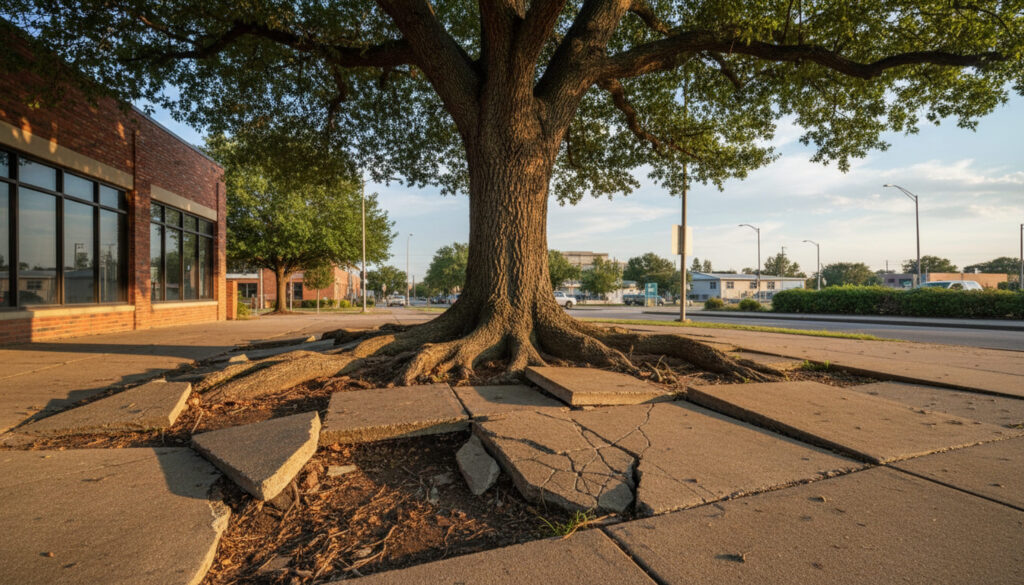
This one is usually the tree. Surface roots run out horizontally, slip under the edge of a slab where the soil is easy, and then do what roots do: they thicken. Iowa State Extension calls it secondary growth, and it is the pressure that buckles and lifts concrete. Nothing is pushing sideways. The root needs more room each year than the slab is willing to give.
Species matters enormously here. Species known for heavy surface rooting include Norway maple, red maple, sugar maple, ash, sweetgum, tulip tree, pin oak, poplars, and willows. Walk any older street in Howell, Jackson, or Freehold, and you will pass a dozen of them, most planted back when the driveway was half its current width.
Grinding the raised lip down flat is cheap, and it kills the trip hazard. It also does nothing about the root, which keeps growing. Expect to be back at it in a few years.
How do tree roots get into a sewer line?
Through a crack or joint that was already leaking. N.C. Cooperative Extension states it flatly: tree roots cannot create cracks in a sewer pipe and can only exploit existing gaps.
Read that again, because almost every article on this topic has it backwards. If there are roots in your lateral, the pipe failed before the roots showed up. They found the leak. They did not cause it.
The practical consequence is money. Take the tree down and you still have a broken pipe under the yard, plus a stump and a bill. Old clay tile and cast iron are the lines that give out; modern PVC should last 100 years or more. So the first call is a camera inspection, not an estimate on the tree.
People also assume they can plant their way out of it. Roots travel two to three times the height of the tree, so moving a sapling five feet off the lateral accomplishes nothing at all. The actual reason to keep trees off a sewer run is simpler: when the line eventually needs digging up, you do not want to lose a mature tree to get at it.
Can you cut the roots instead of removing the tree?
Sometimes. It depends on how thick the root is and how close to the trunk you would be cutting, and the numbers are not generous.
Stay off roots thicker than two inches. Buttress roots should not be severed closer to the trunk than three times the trunk diameter measured three feet up, and once you are inside 1.5 times that figure, taking the whole tree is the safer decision. Cut too close, and you get the worst outcome available: a tree that looks fine, stands upright, and has lost the anchorage it needs for the next nor’easter.
Cut roots also come back. Pairing the cut with a barrier is what keeps them from returning to the same spot.
Do root barriers work, and how far from the house should a tree go?
Barriers work, with conditions. They need to be at least 18 inches deep, with the top projecting above the soil and mulch line, and even a properly installed one only makes it harder for roots to get past, not impossible. They also do far more good at planting than retrofitted around a forty-year-old maple.
On spacing, allow four to six feet of rooting width for small trees and ten feet or more for large ones. Under four feet is not a planting spot for anything.
Who pays if it is your neighbor’s tree in New Jersey?
Here, the answer hinges on something most homeowners have never thought about: whether anyone planted the tree.
In Scannavino v. Walsh, a published Appellate Division decision from 2016, roots from a neighbor’s mulberry tore up a cinder block retaining wall in Carlstadt. The wall’s owner sued for around $12,750 and lost. The trees had seeded themselves after the neighbors bought the property, which made them a natural condition, and a natural condition does not create liability. She had trimmed them every year, and that did not change the result either.
Planted trees sit on the other side of the line. The court treated planting as the affirmative act that sets the whole thing in motion, which makes the tree an artificial condition and the damage actionable.
Either way, you are not stuck. New Jersey has long recognized a homeowner’s right to sever and remove invading tree roots at the boundary line, at your own expense, without setting foot on the neighbor’s property. That is a legal right and nothing more. Whether the cut is survivable for the tree is a separate question, and worth asking first.
FAQs
Will removing the tree stop the damage?
It stops the roots from growing, but it doesn’t repair what they’ve already reached. The lifted slab still needs replacing, and the cracked lateral still needs the pipe fixed.
Which trees cause the most surface root trouble?
Norway, red and sugar maple, ash, sweetgum, tulip tree, pin oak, poplars and willows are all flagged for abundant surface roots. All of them are common on older Monmouth and Ocean County lots.
Do root barriers help around a tree that is already mature?
Less than you would hope, since the roots you want redirected are already past where the barrier would sit. Around established trees, they generally go in alongside root pruning rather than instead of it.
Should I call a plumber or a tree service first?
Call a plumber for a camera inspection. If the pipe is sound, the tree is not your problem. If it is failing, you will know whether the tree has to come out before anyone can dig.